CO2 Laser Resurfacing: What It Is, How It Works, and Who May Benefit in Palm Springs
Fractional Carbon Dioxide (CO2) laser resurfacing stands as one of the most clinically established modalities for intensive dermal skin rejuvenation. Operating at a wavelength of 10,600 nanometers, CO2 energy is intensely absorbed by cellular water within the epidermis and dermis. By delivering targeted micro-ablative thermal columns into the tissue while preserving bridges of untreated skin between them, fractional CO2 lasers trigger a robust physiological healing response that stimulates new collagen and elastin fiber synthesis. At Din Style Aesthetics in Palm Springs, Florida, every CO2 laser resurfacing procedure is carefully planned following a thorough clinical assessment to evaluate skin architecture, pigmentation characteristics, medical history, and aesthetic objectives. Patients who wish to understand how this technology compares with other advanced treatments offered in our Palm Springs clinic—such as non-ablative Stellar M22 phototherapy or ultrasound-based Sofwave lifting—can explore those dedicated pages while reviewing whether fractional CO2 resurfacing suits their individual skin concerns.
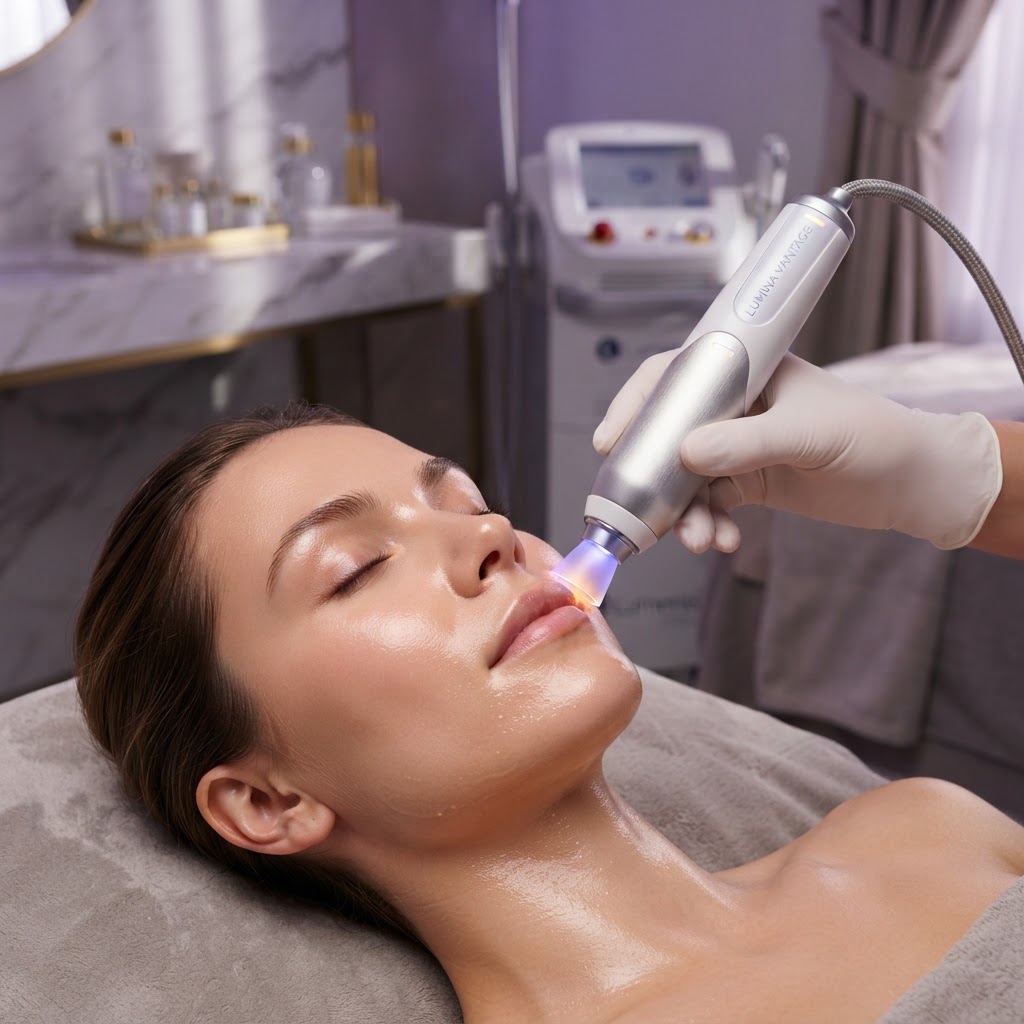
The Physics and Physiology of Fractional Ablation
Understanding how fractional CO2 lasers operate requires an examination of laser-tissue interactions. The 10,600 nm wavelength emitted by carbon dioxide gas lasers targets chromophore water molecules present in skin cells. When the laser light strikes the tissue, water rapidly vaporizes, causing instantaneous micro-ablation of microscopic columns termed Microscopic Treatment Zones (MTZs). Surrounding these tiny ablation channels are narrow concentric zones of controlled thermal coagulation. Unlike traditional fully ablative lasers that remove the entire epidermal layer, fractional technology leaves microscopic islands of intact, healthy skin between each laser column. These surrounding viable keratinocytes and fibroblasts migrate rapidly into the micro-wounds, accelerating re-epithelialization within 48 to 72 hours. Simultaneously, the heat delivered into the deep reticular dermis denaturation-shrinks existing collagen fibers while releasing growth factors like TGF-beta that stimulate neocollagenesis over subsequent weeks and months. This dual action—controlled tissue removal combined with deep thermal stimulation—is what distinguishes fractional CO2 from gentler non-ablative approaches and underlies its reputation for producing measurable, durable textural improvement in a single treatment session for appropriate candidates.
Dermal Remodeling: The Timeline of Collagen Regeneration
The clinical transformation observed following fractional CO2 laser resurfacing occurs in distinct physiological phases. Phase 1, the immediate thermal response, involves immediate collagen contraction where triple-helix collagen fibers shorten in response to controlled heat, producing mild acute tissue tightening. Phase 2, the inflammatory and proliferative phase spanning days 1 through 14, involves macrophage clearance of cellular debris and intense fibroblast activation. During this stage, type III collagen is rapidly deposited in the upper reticular dermis. Phase 3, the maturation and remodeling phase, extends from 3 weeks up to 6 months or longer post-procedure. During remodeling, fragile type III collagen is systematically converted into organized, robust type I collagen bundles. This long-term biological process enhances skin density, tensile strength, smooth surface texture, and elasticity over several months following a single treated session. Patients are encouraged to understand that visible refinement continues well beyond the initial healing window, with texture and tone often improving progressively as the dermal matrix matures. This biological timeline also explains why follow-up assessments are typically scheduled several weeks apart, allowing the clinician to evaluate the evolving result before recommending any complementary session.
Clinical Indications Addressed by CO2 Laser Energy
In clinical practice at Din Style Aesthetics in Palm Springs, fractional CO2 laser technology is utilized to address a broad spectrum of structural and textural skin concerns. Among the primary indications are moderate to severe rhytids, particularly deep wrinkles around the mouth (perioral lip lines) and eyes (crow's feet) that do not respond adequately to superficial treatments. Another major indication is post-acne scarring, including boxcar, icepick, and rolling scar patterns where fibrotic tethering bands beneath the skin can be ablated and smoothed. Additionally, CO2 laser energy effectively addresses solar elastosis, actinic dyschromia, coarse skin texture, enlarged pore appearance, and benign epidermal lesions. During your personalized evaluation, your treating clinician assesses whether CO2 laser resurfacing is best utilized as a standalone procedure or integrated into a comprehensive facial harmonization plan alongside complementary modalities. Patients researching related skin concerns may also wish to review our broader skin rejuvenation offerings, since lighter concerns such as uneven tone or superficial texture may sometimes be addressed with less invasive options. The objective is to match the depth and intensity of treatment to the specific concern, avoiding overtreatment when a gentler modality could accomplish the patient's goal with less recovery.
Customizing Energy Parameters for Individual Skin Typologies
No two skin surfaces possess identical structural characteristics, which makes parameter customization essential for safety and efficacy. Fractional CO2 systems permit precise adjustment of energy density (millijoules per micro-spot), density matrix percentages (the proportion of skin surface ablated), pulse duration, and scanning patterns. For fine surface texture and superficial pigment irregularities, lower pulse energies combined with moderate density settings target the papillary dermis with minimal downtime. Conversely, for deep acne scars or severe rhytids, higher micro-pulse energies penetrate deeper into the reticular dermis to release tight fibrotic tissue and stimulate deep collagen synthesis. At our Palm Springs clinic, parameters are calculated specifically for your skin phototype, anatomical treatment area, and tolerance for downtime, ensuring maximal therapeutic benefit while minimizing risks such as post-inflammatory hyperpigmentation. This individualized approach is part of what distinguishes a medical aesthetic consultation from a generic service menu. The treating provider also considers the interaction between CO2 resurfacing and any other procedures the patient may be planning, since the sequence and spacing of treatments affects both safety and the quality of the final result. Patients should feel comfortable asking their provider to explain the specific settings being recommended and the reasoning behind each choice.
The Consultation and Diagnostic Process in Palm Springs
Your treatment pathway at Din Style Aesthetics begins with an extensive in-person consultation at our luxury Palm Springs location. During this encounter, your clinician conducts a structured diagnostic review including high-resolution cutaneous examination, medical history analysis, assessment of prior aesthetic interventions, and identification of specific textural concerns. We discuss your lifestyle, work commitments, and social calendar to establish an appropriate treatment depth and realistic post-procedure healing window. Clear pre-conditioning protocols—such as topical melanin suppressants or barrier-strengthening preparations—may be prescribed for 2 to 4 weeks before the procedure for appropriate candidates. Every patient receives a comprehensive overview of expected healing stages, post-laser skincare requirements, and personalized pricing before any treatment is scheduled. This conversation is also when the clinician determines whether CO2 resurfacing is the right first step or whether a staged plan starting with a gentler modality would better suit the patient's skin condition and recovery preferences. The consultation includes a candid discussion of expected results, the degree of improvement that is realistic for each concern, and the aftercare commitment required to protect the investment in the procedure.
Realistic Expectations and Long-Term Skin Health
Setting realistic expectations is a cornerstone of ethical aesthetic care. Fractional CO2 laser resurfacing produces genuine structural improvement in skin texture, tone uniformity, and dermal density, but it does not halt the natural aging process or prevent future sun damage. Results are durable but not permanent; maintenance of improved skin quality depends on consistent sun protection, a supportive skincare regimen, and overall skin health habits. Patients should understand that while a single comprehensive session often achieves substantial visible improvement, the full extent of collagen remodeling continues to unfold over six months or more. Some concerns, such as deep icepick acne scars, may benefit from a combination approach that pairs resurfacing with other targeted techniques. At Din Style Aesthetics in Palm Springs, we emphasize honest dialogue about what the treatment can and cannot accomplish so that each patient can make an informed decision. Following the procedure, a structured maintenance plan and ongoing sun protection are essential to preserve the renewed skin quality and protect against recurrent photodamage.
Who May Benefit From CO2 Laser Resurfacing?
Adult patients experiencing moderate to advanced skin textural irregularities, deep perioral or periocular rhytids, post-acne scarring, or pronounced actinic damage may be suitable candidates for CO2 laser resurfacing. Individuals who desire comprehensive structural dermal renewal and are prepared for a planned post-treatment recovery period generally find this approach aligns well with their clinical goals. During consultation at our Palm Springs facility, skin elasticity, thickness, baseline pigmentation, and prior aesthetic history are thoroughly evaluated. Candidates often include those who have already tried lighter skin rejuvenation options and now seek a deeper, more structural result. Patients whose primary concern is surface roughness, coarse texture, enlarged pores, or uneven tone related to long-term sun exposure may also benefit. The treating provider assesses whether the expected degree of improvement justifies the recovery commitment and whether CO2 resurfacing should be performed alone or as part of a sequenced facial harmonization plan.
Who May Need Another Option or Further Assessment?
Patients with active cutaneous infections, active viral herpes simplex lesions in the planned treatment zone, an active diagnosis of keloid scarring, recent isotretinoin use within the preceding 6 to 12 months, or Fitzpatrick skin phototypes V and VI with high baseline melanin activity require specialized clinical assessment. Non-ablative modalities, energy-based alternatives like Sofwave or Stellar M22, or pre-treatment skin conditioning protocols may be recommended prior to or in place of ablative laser resurfacing. Individuals who cannot accommodate the required social downtime, those with occupations involving unavoidable sun exposure, or patients who are pregnant or nursing should also postpone or seek alternative options. A thorough in-person evaluation in Palm Springs is the only reliable way to determine suitability; skin phototype, healing history, and current medication use all influence whether ablative resurfacing is appropriate or whether a gentler, staged approach would better serve the patient.
Frequently Asked Questions
What makes fractional CO2 laser different from non-ablative lasers?
Fractional CO2 laser is an ablative technology that vaporizes microscopic columns of epidermal and dermal tissue, producing deeper collagen remodeling and more pronounced textural renewal compared to non-ablative lasers, which heat dermal tissue without removing surface skin.
How many sessions of CO2 laser resurfacing are typically needed?
Many patients achieve significant structural improvement after a single comprehensive fractional CO2 session. Severe acne scarring or advanced photodamage may benefit from a planned series of 2 to 3 sessions spaced several months apart.
Is fractional CO2 laser safe for darker skin tones?
Patients with Fitzpatrick skin types IV through VI require specialized conservative parameter settings, rigorous pre-treatment melanin suppression, and careful evaluation to minimize the risk of post-inflammatory hyperpigmentation. Alternative energy devices like Sofwave or Stellar M22 may be discussed.
Where is CO2 laser resurfacing performed for Palm Springs residents?
All CO2 laser evaluations and procedures are conducted at Din Style Aesthetics, located at 3003 S Congress Ave #2B, Palm Springs, FL 33461.
Sources and Medical Information
This article is educational and does not replace an individualized medical consultation at our Palm Springs clinic.
Begin Your Consultation at Din Style
We offer personalized evaluations for every treatment at our Palm Springs, Florida clinic. Speak with our team today.
Request a Consultation
Personalized evaluation with our treating providers in Palm Springs.